 Gift vouchers online
What a gift voucher must contain
Who issued the voucher, what it’s valid for, the unique code, its validity period and the terms and conditions of use. A checklist to ensure the voucher doesn’t cause any problems for you or the customer.
· 5 min read
A gift voucher seems like a simple thing: a nice picture, an amount and a signature. But when the recipient turns up eight months later and the voucher cannot be found, or when a customer and the business disagree on exactly what the voucher is valid for, the details start to matter. In this article, you’ll find out what a voucher should include to ensure there are no problems for either you or the customer.
In the Czech Republic, there is no law that prescribes the content of a gift voucher point by point. The list below is based on the general rules of the Civil Code and on common practice. This is not legal advice – if you are unsure, consult a lawyer or an accountant.
1. Who issued the voucher
The voucher must clearly state where it can be redeemed. Please include:
- the trading name or name of the business,
- company registration number,
- the address of the business where the voucher is to be redeemed,
- contact details – telephone number, email address or website where an appointment can be arranged.
If you have more than one establishment, please state whether the voucher is valid at all of them or only at one.
2. What the voucher is for
This is where most misunderstandings arise. Distinguish between two types of vouchers:
Service voucher
Describe the service in such a way that it cannot be interpreted in two different ways: not simply ‘massage’, but ‘classic back and neck massage, 60 minutes’. If the price of the service may change in the future, state that the voucher is valid for the service with no additional charge – or, conversely, that it is for a specific amount in crowns.
Voucher
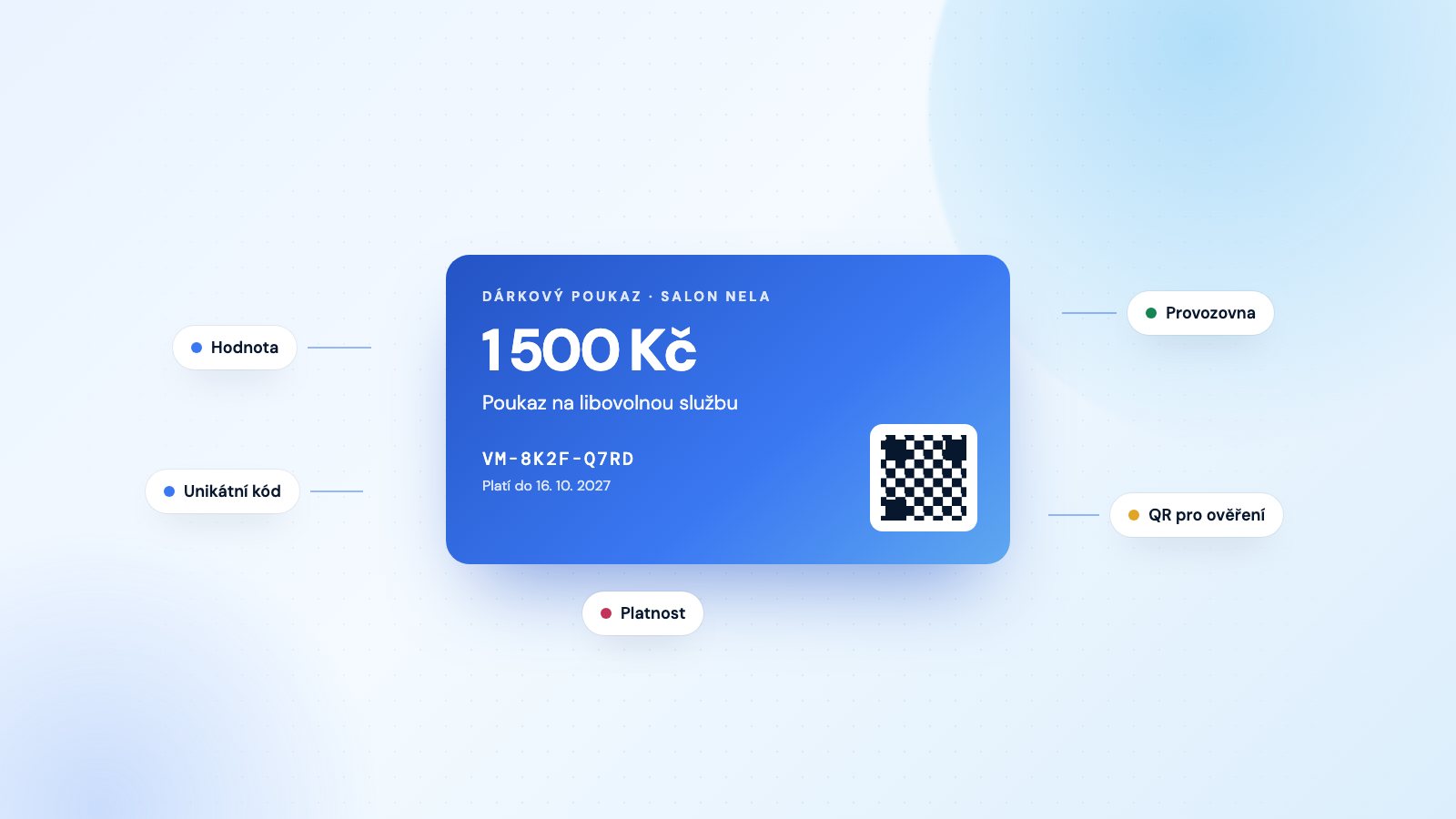
State the amount and currency, for example “1,000 Kč”. Add a note specifying what the value can be used for: all services, goods, or only a selected range of products.
3. Unique code
Every voucher needs its own code or number so that you can track it. Without it, you have no way of verifying that the voucher is not a copy and that it has not already been redeemed. The code should not be easy to guess – a sequential number such as “0001, 0002…” offers little protection.
A QR code is ideal. In Vouchermat, there’s one on every voucher, and in the mobile app, you simply scan it: you can immediately see whether the voucher is valid, how much credit remains, and when it was redeemed.
4. Valid until a specific date
Specify the exact date, for example, “valid until 31 December 2027”. The wording “valid for one year from purchase” forces the recipient to try to work out when the giver bought the voucher – and the giver often doesn’t know.
We discuss how long to set the validity period for and what happens to an expired voucher in a separate article: How to set a voucher’s validity period (and what the law says).
A voucher order form in 10 minutes
Free, no card and no commission.
5. Terms of use
Write briefly and clearly how to use the voucher. Typically:
- whether a booking needs to be made in advance and how,
- whether the voucher can be used in instalments (for value-based vouchers),
- that the voucher cannot be exchanged for cash,
- whether it is transferable – gift vouchers usually are, as they are bought for someone else,
- what happens if it is lost: if you can trace the voucher using the code or the giver’s email address, state that you can reissue it.
There should be no more terms and conditions than can fit on the voucher or in a short paragraph in an email. Details belong in the terms and conditions.
6. Optional, but useful
- Recipient’s name and a personal message – this makes the voucher more personal. On Vouchermat, the customer fills this in directly on the form.
- Date of issue – this helps when dealing with complaints.
- Business logo and colours – this makes the voucher look like a proper gift, not just a receipt.
- A link or QR code for booking – the recipient can book straight away.
Terms and conditions and distance selling
When you sell vouchers via your website, you are entering into a distance contract with the customer. The terms and conditions for the sale of vouchers should therefore be available on the website: who the seller is, how payment is made, how and when the voucher will be delivered, how long it is valid for, and how complaints are handled. In general, consumers have the right to withdraw from a contract within 14 days for distance sales; check with a solicitor to see whether and how this applies to your specific voucher, and describe this clearly in the terms and conditions.
VAT: single-purpose and multi-purpose vouchers
If you are a VAT payer, it depends on the type of voucher. Tax regulations distinguish between single-purpose vouchers (where it is clear at the time of sale what is being sold and at what tax rate) and multi-purpose vouchers (for example, a voucher for various goods and services with different tax rates). This determines when the tax is payable – whether at the time of sale of the voucher or only when it is redeemed. Discuss the correct classification with your accountant.
Checklist
- business name, company registration number, address and contact details,
- precise description of the service, or amount in CZK,
- unique code, ideally a QR code,
- valid until a specific date,
- terms of use: booking, use in instalments, exchange for cash,
- link to the terms and conditions,
- optionally, the recipient’s name, a dedication and a logo.
In Vouchermat, the unique code, QR code and expiry date are automatically added to each voucher, so you don’t need to keep track of them manually. The voucher, featuring your logo, will be sent to the customer by email as a PDF. You can try this out with the Free plan.